Phototherapy
Every photograph is a self-portrait.
Your images can help you find your way back to yourself - even to those parts that may have been waiting for you for a long time.
„Photography can be used to explore all these different levels of their life - starting from self-image, right through to interpreting the environment and society.”
- Neil Gibson
What is the connection between images and neuroscience?
Images are one of humanity’s oldest ways of thinking. Long before language emerged, people organized their experiences through symbols, gestures, and mental images.
According to neuroscience, the brain processes images faster and more deeply than words. A meaningful image can activate neural networks responsible for empathy, emotions, memory, and decision-making.
When someone looks at a photograph, the amygdala, the hippocampus, and the medial prefrontal cortex are also activated. For this reason, viewing images is not a passive process, but a direct gateway to emotions. Photography can help reinterpret lived experiences, recognize cognitive or emotional patterns, and thereby deepen self-awareness.
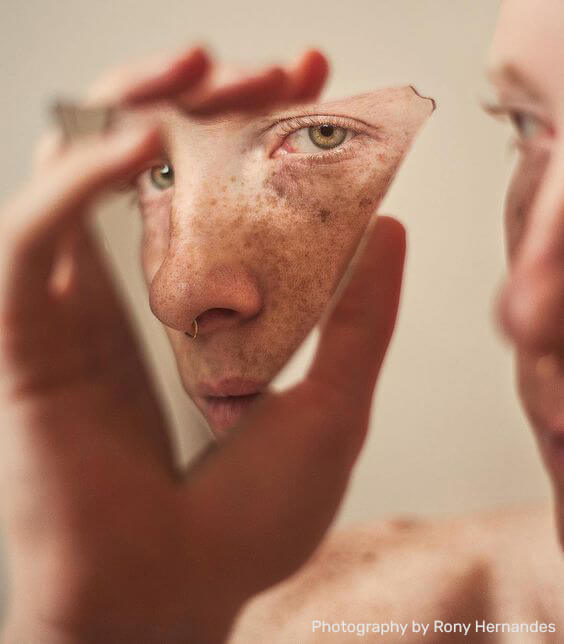
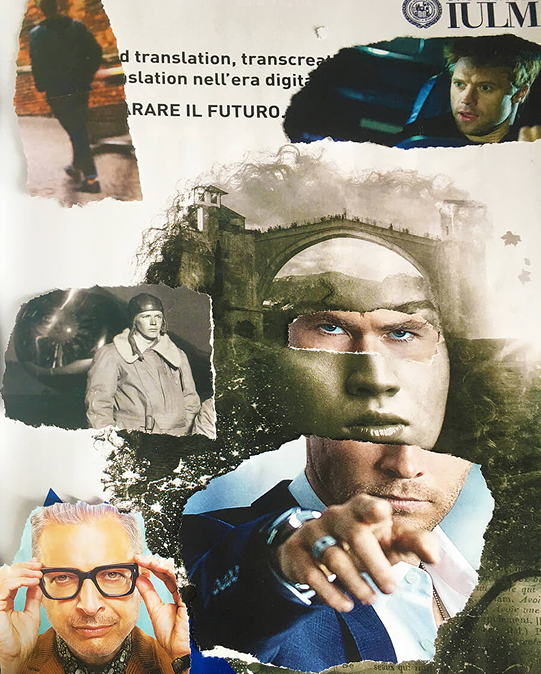
An image shows a human face, partially covered by an irregularly shaped mirror fragment held in a hand. A photo collage made of different portrait photographs, in which several faces appear in fragments, layered over one another.
How does phototherapy work?
Photographs can open inner doors that are difficult to access through other approaches. Each image reflects important moments, emotions, and relationships in our lives - functioning as a personal mirror.
During phototherapy, various visual methods are used, such as photo projection, image meditation, photo collage, self-portrait work, and autobiographical or family photographs. These processes support a deeper understanding of both ourselves and the world around us. The work invites new perspectives, allowing past experiences to connect with present awareness and future intentions, while the inner world is explored through creative expression.
How does phototherapy work?
Photographs can open inner doors that are difficult to access through other approaches. Each image reflects important moments, emotions, and relationships in our lives - functioning as a personal mirror.
During phototherapy, various visual methods are used, such as photo projection, image meditation, photo collage, self-portrait work, and autobiographical or family photographs. These processes support a deeper understanding of both ourselves and the world around us. The work invites new perspectives, allowing past experiences to connect with present awareness and future intentions, while the inner world is explored through creative expression.
How can phototherapy help?
According to research, this method can support:
- increasing self-esteem and a sense of identity,
- expressing emotional pain and reframing it from new perspectives,
- supporting emotional self-regulation through conscious attention,
- strengthening cognitive flexibility, which is especially helpful in cases of anxiety and depression,
- enhancing the sense of connection and belonging in community settings,
- stimulating creativity as a process of emotional regeneration.
Many people discover through photography a way to reconnect with parts of themselves that may have been forgotten - especially during life transitions, grief, trauma, or periods of inner rebuilding.

How do the sessions take place?
- In individual and group formats.
- Through interactive exercises: image creation, analysis, and conversation based on photographs created or brought by the participants.
- Through emotional and symbolic image analysis: exploring and discussing the emotional messages contained in the images.
- With the use of creative tools: transforming photographs through collage and montage work.
The intention of the process is to support emotional integration, deepen self-understanding, and nurture physical, mental, and emotional well-being through images.
How do the sessions take place?
- In individual and group formats.
- Through interactive exercises: image creation, analysis, and conversation based on photographs created or brought by the participants.
- Through emotional and symbolic image analysis: exploring and discussing the emotional messages contained in the images.
- With the use of creative tools: transforming photographs through collage and montage work.
The intention of the process is to support emotional integration, deepen self-understanding, and nurture physical, mental, and emotional well-being through images.
Feedback About Me:
Phototherapy offers a different way of approaching inner experiences - beyond words, without force, gently opening space for the nervous system to release what it has been carrying for a long time.
ARTfo Studio donates 10% of its profits to civil organizations that support positive social change.
© 2023 All rights reserved | Privacy Policy | Cookie Policy

